


Call us : (+91) 9335 912 616
Mail us : institute@icsmail.in
Connect
with Us
with Us


Member of the UP Government’s prestigious steering committee for the implementation of the National Education Policy (NEP) 2020.
Advisor to a number of educational institutes and has served on the boards of many prestigious schools like the Woodstock School, Mussoorie.
Currently, board member of the Avadh Girls' Post Graduate College, Lucknow, Auckland House School, Shimla, Bishop Cotton School, Shimla, Nirmal Bhartia School, New Delhi and Wynberg Allen, Mussoorie.
Has been advisor to SIDBI, Member – Steering Committee on Women and Child Development, Planning Commission (9th Five Year Plan) and Ex-officio Director of the State Bank of India.
Organised conferences on Education 4.0 and Careers 4.0 in 2018, bringing together all stakeholders to make our students future ready. These were the first events of their kind to be held in the world – reflecting deep knowledge, insight and futuristic vision.
Has designed and conducted numerous programmes on:
Leadership in Education for Edu-Leaders
Excellence in Education for Teachers
Knowledge and Skills for Career Counsellors
Leadership and Management for NGOs and Corporates
Has participated in many international conferences such as:
UN Social Summit – Denmark
UN Conference on Women – China
State of the World Forum – USA
Global Knowledge Partnership – Malaysia, supported by the World Bank
Writes on a wide range of educational, career and leadership issues, as a columnist for many prominent newspapers, magazines, portals and blogs.
Lions Club Award for Outstanding Social Work
Rotary Award for Vocational Excellence
TCS-Woman Achiever of the Year Award
Outstanding Woman Achiever Award by the Lucknow Management Association (LMA)
* Her biography has been included in the Who’s Who in the World 2015 (32nd Ed.) for exemplary contribution in the fields of Education and Career Guidance.
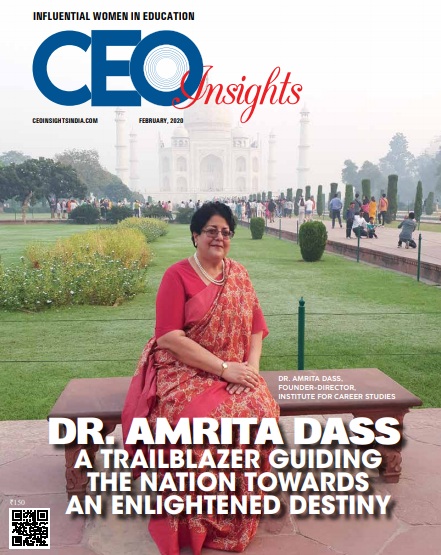
* In February 2020, Dr Dass was featured on the cover page of CEO Insights magazine as a ‘Trailblazer guiding the Nation towards an Enlightened Destiny’.
Dr Dass has had a meritorious academic background. Her qualifications include:
MA, Western History, University of Lucknow ; awarded two gold medals
Doctoral Studies, SOAS, London University, as a fellow of the Indian Council of Historical Research (ICHR)
PhD, Western History, University of Lucknow
Diploma in French (2 years), Department of English and Foreign Languages, University of Lucknow

Contributions as an Educationist:
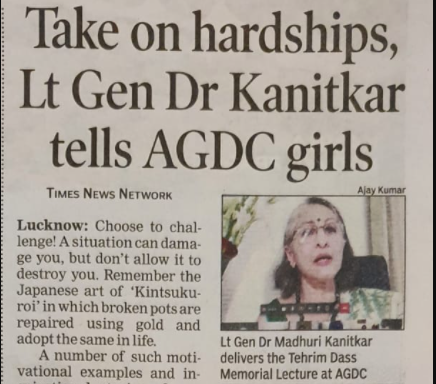
Member of the UP Government’s prestigious steering committee for the implementation of the National Education Policy (NEP) 2020.
Advisor to a number of educational institutes and has served on the boards of many prestigious schools like the Woodstock School, Mussoorie.
Currently, board member of the Avadh Girls' Post Graduate College, Lucknow, Auckland House School, Shimla, Bishop Cotton School, Shimla, Nirmal Bhartia School, New Delhi and Wynberg Allen, Mussoorie.
Has been advisor to SIDBI, Member – Steering Committee on Women and Child Development, Planning Commission (9th Five Year Plan) and Ex-officio Director of the State Bank of India.
Organised conferences on Education 4.0 and Careers 4.0 in 2018, bringing together all stakeholders to make our students future ready. These were the first events of their kind to be held in the world – reflecting deep knowledge, insight and futuristic vision.
Has designed and conducted numerous programmes on:
Has participated in many international conferences such as:
Writes on a wide range of educational, career and leadership issues, as a columnist for many prominent newspapers, magazines, portals and blogs.
Dr Dass has had a meritorious academic background. Her qualifications include:
* Her biography has been included in the Who’s Who in the World 2015 (32nd Ed.) for exemplary contribution in the fields of Education and Career Guidance.
* In February 2020, Dr Dass was featured on the cover page of CEO Insights magazine as a ‘Trailblazer guiding the Nation towards an Enlightened Destiny’.


Available on:


Now, experience the benefits of career
counselling free of all hassles from the
comfort of your home !
Free Career Report in 3 easy steps
Free Career Report in 3 easy steps

Looking for Apps for Career Guidance?
Now, experience the benefits of career
counselling free of all hassles from the
comfort of your home !
Free Career Report in 3 easy steps
Free Career Report in 3 easy steps
Free Career Report in 3 easy steps


Class 10 is not all about Boards. It’s a crucial year for subject selection. Look beyond Arts, Commerce & Science. Kickstart your dream career journey today!
Register for holistic career test battery
Established
in 1985
Career interests assessment
Reached out to over 450,000 people

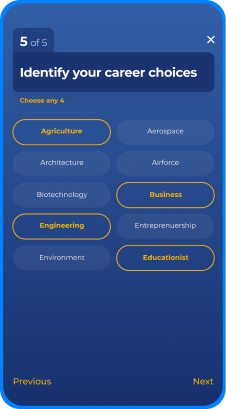
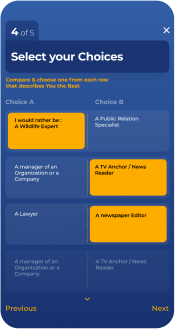
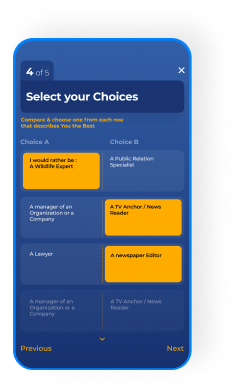
We have a highly qualified and experienced team of consellors to guide you
Know why Career Counselling is Important?
Established in 1985
Career interest assessment programmes
Reached out to over 300,000 people
Reached out to over 300,000 people
 Pioneers
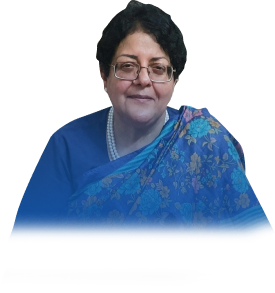
Founder Director, ICS
Chairperson and Managing Director of ICS Education Ltd.

Years of
Experience
Conselled
Students
Trained
Teachers
Educational Institutions Reached
Principals
Trained
Years of
Experience
Students
Counselled
Students
Counselled
Partner
Schools
Educational Institutions Reached
Principals
Trained
Students have amazing opportunities to
pursue higher studies in the best international
campuses – often with scholarships!
ICS has a global presence today. With its expert, dedicated and highly experienced team of career counsellors and professionals from different domains
Unlock limitless possibilities for higher
education in India and effortlessly navigate
through the intricacies of college admissions,
securing your spot at the campus of your dreams.
ICS has a global presence today. With its expert, dedicated and highly experienced team of career counsellors and professionals from different domains
Highlights your potential & passion; Brings Clarity
Fine-tunes choices with ‘RIGHT COURSE-RIGHT CAMPUS-RIGHT CAREER’ fit
Provides EXPERT GUIDANCE instead of well-wishers’ well-meant but often flawed suggestions
Gets you the much-needed PARENTAL SUPPORT
Helps you NAVIGATE CAREERS in these challenging times
Finds holistic solutions to problems such as a FINANCIAL CRUNCH
Is Your GPS for LIFE!
Many students face difficulties in deciding on a suitable career path and pursuing it.
Career confusion is natural and is associated with the development of wider knowledge and deeper understanding.
It shows that you are trying to explore several options.
Timely and expert career guidance helps you reach your dream career.
Revise Effectively
Solve Model Test Papers
Make a Smart Study Schedule
Read Questions Carefully; Time your Answer
Focus on Presentation
Complete Before Time to Check your Answers
Understand Important Terminologies
Start serious preparation from Class 11 onwards
Build a strong foundation of PCM in Classes 9-10
Use special tools to master the IIT-JEE level questions
You also need someone to mentor you on:·
- How to clear your fundamentals·
- How to do self-study·
- How to manage your time and stress levels·
- How to equip yourself with additional tools to improve your strike-rate
A career in space can be pursued from any subject combination
For Space Tech, take STEM classes along with Biology, Chemistry & Geosciences
Become a Space Buff!
Be prepared to study and put in hard work
Volunteer to be a part of space-related projects
Develop these skills: Mathematics; Critical thinking; Complex problem-solving; Intrinsic motivation; Determination; Enthusiasm; Love for learning; Patience and Team Spirit.
Cyber Safety careers are among the most sought-after today
Some trending job opportunities in the field are:
1. Network Security Engineer
2. Security Analyst
3. Security Architect
4. Security Manager
5. Chief Information Security Officer
6. Cyber Lawyer
The terms Big Data Engineering and Artificial Intelligence Engineering are often used interchangeably.
This is because these fields require overlapping skill-sets.
The two areas are actually quite different.
Understanding this difference will help you decide which specialization suits you better.
The SaaS Industry is growing at twice the pace of the overall IT market.
The recent global challenges have created a further push toward SaaS, with six Indian SaaS unicorns launched during 2020.
The demand for engineers is overflowing, especially after the new ‘digital transformation’ wave.
Design Architect
Software Designer
System Validation Engineer
3D Artist
Big Data explosion
Continuous emergence of new and better Data Analysis technologies
Growing awareness of Data Trend studies helping make informed business decisions
Joyful learning with understanding
No subject stream silos
Equal weightage to curricular, co-curricular and extra-curricular
Reforms in assessment system
Transforming teacher training
Revolutionising higher education
Human Rights activist:·
Document human rights violations·
Publicise the violations on a wide scale·
Press the authorities concerned to stop the violations·
Publicise the work of activists through media
Gender Studies & Activism aim at:·
Examining the diversity of gender-based experiences· Correcting misconceptions about different genders· Highlighting the problems of marginalised genders in society· Devising appropriate strategies for change
Big Tech Opportunity
Big Consulting Job
Joining the 'Hot Start-up'
Direct Make-or-Break Path
Investment & Banking Role
Sales & Customer Service
Solopreneurship
Here are four types of design careers that are trending today:
Product Design
Communication Design
Interaction Design
Interdisciplinary Design
Hospitality students tend to perform well in all services!
Excellence in the future will be defined by the quality of human interactions.
This is why other industries are actively recruiting hospitality graduates.
Options for job seekers include:
-Using skills acquired across the hospitality value chain in other sectors
-Graduates pursuing higher education and enriching their professional profile
-Upskilling through value-adding courses
-Starting your own entrepreneurial venture

Benefited 450,000+ students in 1,000+
educational institutions across the world.
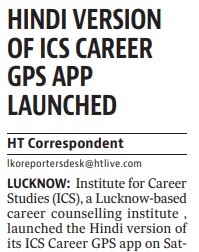
ICS conducts regular career guidance programmes across
India, South and South-East Asia, and the Middle East.